This site uses cookies for analytics and to improve your experience. By clicking Accept, you consent to our use of cookies. Learn more in our privacy policy.
Most of us have now had the first AI experience: you ask ChatGPT (or Claude, or Copilot) to draft an email, summarise a supplier price list, or explain what “DTF printing” actually is, and it does a decent job in seconds. That’s AI as a chat assistant, acting as a very well-read colleague you can bounce things off.
The next step is much more interesting, and it’s already happening: AI as an agent, software that doesn’t just tell you things, but actually does things. Drafts the quote and drops it into your system. Chases the artwork approval. Checks stock with the supplier and updates the order. For a promotional merchandise business drowning in repetitive admin, that’s where the real time savings live.
But there’s a catch, and it’s worth understanding before you make the jump. It comes down to one unglamorous word: grounding.
Why the jump from chatting to doing raises the stakes
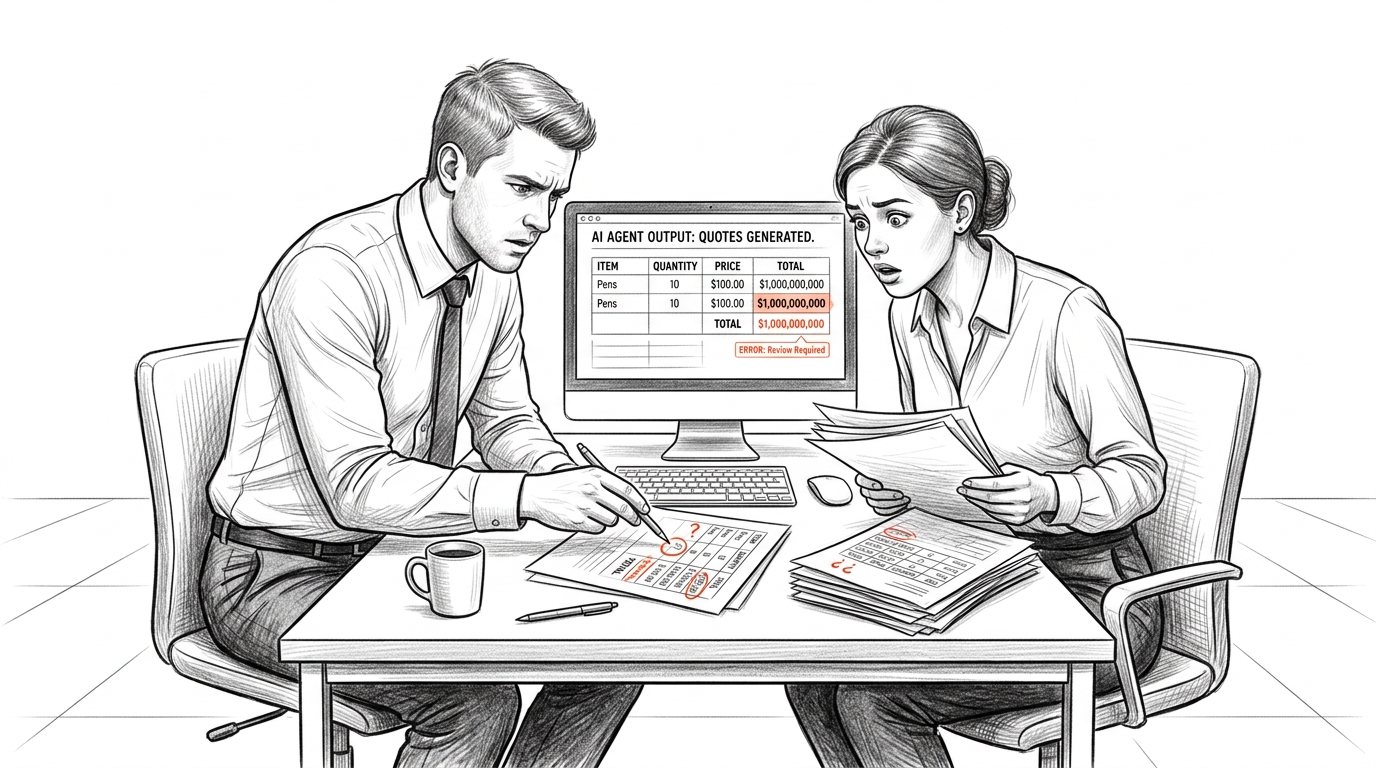
When AI is just chatting, a wrong answer costs you a few minutes. You read it, think “that’s not right,” and move on. When AI is acting, a wrong answer becomes a wrong quote, a wrong order, or a promise your business is now expected to keep.
That’s not a hypothetical. In 2024, a Canadian tribunal ordered Air Canada to compensate a passenger after its website chatbot invented a bereavement fare policy that didn’t exist — and rejected the airline’s argument that the chatbot was “a separate legal entity responsible for its own actions.” If your AI tells a customer something, you own it.
It gets more expensive as the work gets more important. In 2025, Deloitte partially refunded the Australian government after a AU$440,000 report was found to contain fabricated academic references and a made-up quote from a court judgment. AI-generated content that nobody had properly checked. And in one widely reported case the same year, an AI coding agent at Replit went a step further than writing anything at all: it deleted a company’s live database during a code freeze, prompting a public apology from the company’s CEO. In the legal world, a tracker maintained by researcher Damien Charlotin has now logged more than 1,800 court cases worldwide in which lawyers were caught filing documents containing AI-fabricated citations.
Different industries, same underlying story: AI output that sounded confident, wasn’t checked against anything real, and was allowed to reach the point where it had consequences.
Why AI makes things up in the first place
This isn’t AI being careless, and it isn’t a bug that next year’s model will simply fix. Large language models work by predicting the most plausible next words based on patterns in their training data. Researchers at OpenAI published a paper in 2025 explaining that models hallucinate partly because of how they’re trained and tested: the process rewards confident guessing over admitting uncertainty just like a student who never leaves an exam answer blank, because a wrong guess scores better than “I don’t know.”
So a raw language model asked “what’s our trade price on 500 printed mugs?” will happily produce a plausible-sounding number. Plausible is what it’s built for. Correct requires something extra.
Grounding: giving the AI an open-book exam
That something extra is grounding. Grounding means connecting the AI to real, verifiable sources of information such as your price lists, your product data, your terms of business, a supplier’s live stock feed and requiring it to base its answers on what it finds there, ideally with citations showing exactly where each claim came from. Google and Microsoft both now build grounding and “groundedness checking” into their enterprise AI platforms, which tells you how central it has become.
The best-known grounding technique is retrieval-augmented generation (RAG), first described by researchers in 2020. The idea is simple: instead of asking the model to answer from memory, the system first retrieves the relevant documents, the right page of the right price list and then hands them to the model along with your question. It turns a closed-book exam into an open-book one. The model stops guessing what your prices probably are and starts reading what they actually are.
For a business, grounding buys you three things. Answers based on your data rather than the internet’s averages. Citations, so a human can check where a claim came from. And a system you update by updating your documents; so new price list in, new answers out – with no mysterious retraining involved.
There’s a caveat: grounding reduces errors, it doesn’t abolish them
Here’s the part vendors tend to whisper. A Stanford University study tested premium legal AI research tools built on RAG, products whose marketing claimed to “avoid” hallucinations and found they still produced incorrect or misgrounded answers between 17% and 33% of the time. That was a big improvement on general-purpose chatbots, but a long way from perfect. If your knowledge base contains an out-of-date price list, a grounded AI will faithfully cite the wrong price with a lovely footnote.
The practical conclusion isn’t “don’t bother.” It’s that grounding is necessary but not sufficient but it needs to be paired with sensible checkpoints. Which brings us back to the bridge between chatting and doing.
Crossing the bridge safely
The move from chat assistant to acting agent doesn’t have to be a leap. Sensible businesses cross it in stages:
Grounded answers first. Start with an assistant that can only answer from your own documents, and shows its sources. This is where you find out how good (or stale) your product data, pricing and policies really are.
Drafts, not deeds. Next, let the AI prepare actions — draft the quote, pre-fill the order, write the chase-up email with a human clicking “send.” You get most of the time savings while a person still owns every consequence.
Narrow autonomy, with limits and logs. Only once a task has proven itself do you let the AI complete it end-to-end — and even then, within tight boundaries (order values it can handle, actions it can never take) and with a log of everything it did and which sources it relied on.
Notice what makes stages two and three possible at all: the grounding you built in stage one. An agent is only as trustworthy as the information it acts on. Get the plumbing right with your data, connected, current and citable. Then the exciting stuff stops being a gamble.
AI that chats is a better search box. AI that acts is a new member of staff. And like any new member of staff, it should be given the company handbook, access to the real files, clear limits on what it can sign off, and a manager who checks its work until it’s earned trust. That’s grounding, and it’s the difference between AI that impresses in a demo and AI you’d actually let near your customers.
Most promotional merchandise is chosen for how visible it is – but visibility and influence are not the same thing, and buyers who confuse them waste budget.
Ask most buyers why they chose a particular branded item and the answer usually comes back to visibility: a big logo, a bright colour, something that “gets seen”. But visibility is not the same as influence. A pen that sits in a drawer has been seen exactly once, at the moment it was handed over, and it has changed nothing about how the recipient behaves.
The promotional merchandise industry has spent decades optimising for impressions rather than outcomes, because impressions are easy to count and outcomes are not. Yet the psychology behind why merchandise works at all has very little to do with logo size. It has to do with reciprocity, utility and repeated contact.
Reciprocity is well documented in behavioural science: when someone receives something useful or thoughtful, they feel a mild, largely unconscious obligation to reciprocate, whether through attention, loyalty or a purchase. Utility extends the effect over time. An item used daily, such as a decent water bottle or a genuinely good notebook, keeps a brand in view for months rather than seconds, and each use reinforces a small positive association. Repeated contact compounds both effects: five low-value touches, spread out over time, often outperform one expensive one.
None of this means expensive or highly visible items are wrong. A striking item at a trade show still has a job to do, drawing people to a stand. But when the objective shifts from “get seen” to “get chosen again”, the selection criteria need to shift too. The right question stops being “will this get noticed?” and becomes “will this change what someone does next: will they remember us, recommend us, or come back to us?”
For distributors, this reframes the conversation with clients away from unit price and logo placement and towards intended behaviour: is this gift meant to open a door, close a deal, retain a member of staff, or build a habit? For end-user buyers, it means being honest about what success looks like before browsing a catalogue, not after.
The businesses getting the most from their merchandise spend are the ones treating it as a small, deliberate nudge towards a specific behaviour, not a marketing afterthought measured in units shipped. It is a modest shift in thinking, but it changes almost every decision that follows: what to buy, who to give it to, and how to know if it worked.
If you want help mapping merchandise decisions to the behaviours you are actually trying to change, Six Different Ways runs AI Roadmap Sessions built for exactly this kind of question. Get in touch to find out more.
Enterprises have spent two years and serious money learning to use AI without leaking data. Most of that journey, a smaller firm can skip.
Picture a sales rep at a promotional merchandise supplier, between meetings, clearing a backlog of quotes from a phone. A distributor has sent through a brief; client name, budget, the artwork they’re after. It needs turning into a polished response before the next appointment. So the rep opens ChatGPT, pastes the brief straight in, and asks for a draft. Reply sorted, on to the next one.
Nothing about that feels reckless. It’s quick, it’s free, and it works. But that brief has just left the building. It’s gone into a tool the company never chose, on an account nobody controls, and where it ends up next is anyone’s guess. To be clear, this is not about OpenAI’s servers being compromised, networks log traffic, data can leak throughout its journey.
This has a name now: shadow AI, staff using AI tools the business hasn’t sanctioned, usually with the best of intentions. And it’s the clearest single example of a bigger story, one that large companies have spent the past two years working through, often the hard way. The useful part for a smaller business is that you can read the map before making the journey.
What the big companies learned
Microsoft’s 2026 Data Security Index surveyed more than 1,700 security leaders at large organisations. A caveat that actually matters: every one of those companies has 500-plus staff, and many have a dedicated security chief. So the numbers are not about firms your size. The principles behind them are — and separating the two is the whole point of what follows.
Read across the report and a pattern emerges that looks a lot like a journey in three stages. First, large companies noticed their people were quietly using AI everywhere, and panicked a little. Then they put controls in place. Now, increasingly, they’ve turned AI into something they use to defend themselves rather than just worry about. Call it a maturity curve.
The early panic is easy to see in the data. Almost a third of these organisations — 32% — say AI was involved in at least one of their data security incidents. In response, the share putting specific controls around staff AI use in place climbed from 39% to 47% in a single year. That is a lot of large, well-resourced companies all reaching for the brakes at once.
None of the specific machinery they reached for will fit a ten-person supplier, and that’s fine. What carries across is the themes of the lesson, not the specifics. Here are the three to think about.
Lesson one: the risk is universal, and a small firm is more exposed, not less
The thing driving all that enterprise anxiety is straightforward. People like using AI, and they’ll use it whether or not the business has a view. Microsoft’s research found more than 70% of office workers bringing their own AI tools to work — their own accounts, sometimes their own devices, sitting outside anything the company can see.
Smaller firms are doing exactly the same, just without the safety net. The Federation of Small Businesses found that AI use among small firms has nearly tripled in two years, from 20% in 2023 to 55% now. Worry has climbed alongside it: 92% of small firms now have concerns about AI risks, up from 73% two years ago. Security sits high on that list.
Here’s the part worth sitting with. The enterprises in that 32%-of-incidents figure had firewalls. They had blocked tools, approved-software lists, training days. They had a security chief whose entire job was to stop sensitive data wandering off — and it wandered off anyway. A small promotional merchandise business has none of that. Same exposure, fewer guardrails, and usually nobody whose actual job is to notice. The lesson from the enterprise data is not “relax, you’re small.” It’s the reverse.
Lesson two: you can’t protect what you can’t see
Large companies spend heavily on tools that give them a single view of where all their data sits and who’s touching it, the sort of dashboard that makes sense when you’re stitching together fifteen systems across four countries. A small firm needs none of that, and shouldn’t buy it.
But the principle underneath it is one of the cheapest wins available to a smaller business. Before anything can be protected, someone has to know what’s actually happening. For an enterprise that means a dashboard. For a small supplier it means knowing which AI tools the team genuinely uses, and what they’re putting into them — a question you can usually answer over a coffee rather than with software.
This matters because there’s a gap most businesses don’t realise they have. The government’s own research into AI adoption found that even firms already using AI were often unclear about what the tools were actually doing — where the data went, how the thing worked under the bonnet. People were using AI confidently and understanding it barely at all. It’s hard to make sensible decisions about a tool you can’t see and don’t quite understand, which is why visibility comes first.
Lesson three: keep a person in the loop
The newest stage of the enterprise journey is using AI to do security work itself — including AI “agents,” tools that don’t just answer questions but take actions on their own. Even as they adopt this, the same leaders keep flagging one worry: 38% are uneasy about these tools acting without a human checking the work.
A smaller firm will almost certainly never run a security agent. But the instinct to never let AI output go out of the door unchecked is the one defensive idea that transfers intact, and the trade already knows why. Anyone who’s stood at a stand recently has seen the AI-generated artwork problem: a distributor briefs a supplier with a beautiful AI image that simply cannot be produced — colours that won’t print, a finish that doesn’t exist, a decoration method nobody offers. It looks finished. It isn’t. Nobody who knew the job checked it before it went out.
That’s the whole principle in one familiar picture. “Human in the loop” isn’t jargon for something complicated; it just means someone who understands the work looks at what the AI made before anyone relies on it. The artwork that can’t be printed and the quote built on a number the AI invented are the same mistake.
The advantage of being small
Read all this back and it can sound like a warning. It’s closer to the opposite. The large companies in that Microsoft research spent the better part of two years and real budget climbing the curve from panic to sensible use. A smaller business can skip most of that middle, precisely because it’s small.
A firm of five hundred people needs committees and platforms and a change programme to get a grip on how staff use AI. A firm of twelve needs a conversation and a single side of A4. The same outcome that takes an enterprise eighteen months is, for a small business, mostly a Tuesday afternoon. Size is the advantage here, not the handicap.
Where to start
If you want a concrete first step that costs nothing, the National Cyber Security Centre — the UK’s official cyber body — has built a free Cyber Action Toolkit aimed squarely at organisations with fewer than 50 staff. There are 5.5 million such organisations in the country, and the toolkit is deliberately built for people with no IT department, putting the high-impact, low-effort actions first. It pairs naturally with Cyber Essentials, the government-backed certification that shows customers you take their data seriously — increasingly something distributors and end clients actually ask about.
The AI-specific piece is simpler than it sounds: one page that says which tools are fine to use, and what should never be pasted into them — client lists, pricing, anything you wouldn’t email to a stranger. That single page does most of the work an enterprise spends a fortune on.
Which brings us back to the rep with the phone and the distributor’s brief. The fix was never to ban the tool, the tool is genuinely useful, and banning it just drives it further underground. The fix is that the rep knows, before pasting, what’s fine to share and what isn’t. That’s it. That’s the whole journey the big companies took, minus the eighteen months.
There’s a good deal more in the FSB’s research than the headline figures — a detailed picture of what small firms are actually worried about when it comes to their data, their intellectual property, and who carries the can when an AI tool gets something wrong. That’s a piece in its own right, and it’s the one we’ll write next.
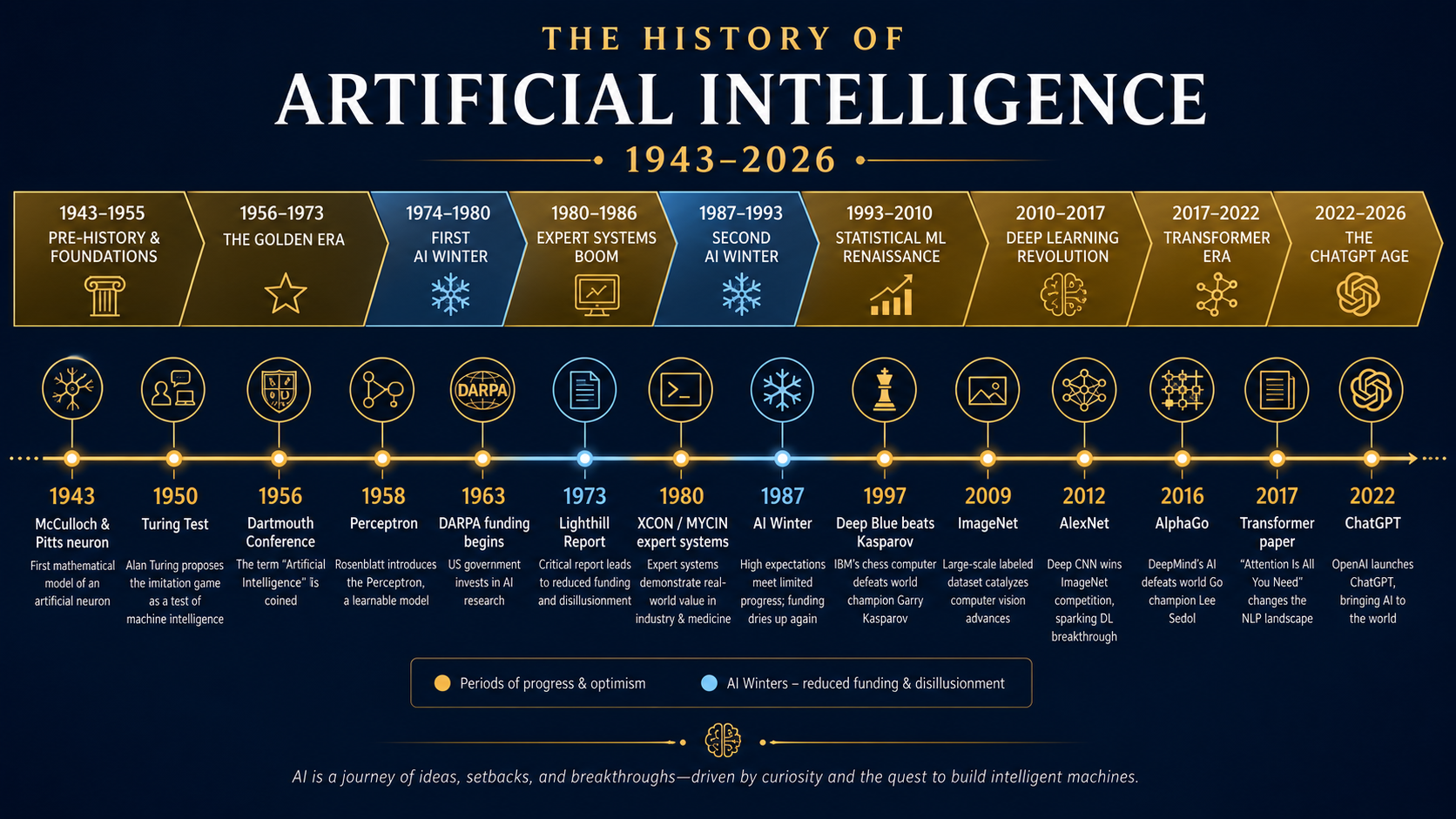
It is the accumulated product of eight decades of mathematics, military funding, corporate ambition, academic inquiry, and hardware revolutions — most of it invisible to the public until the moment it wasn’t.
Overview
When presenters say “AI has been around for a long time,” they are correct — but the statement barely scratches the surface. The field of artificial intelligence as a formal discipline is almost 70 years old, and its intellectual roots run back to the 1940s. What has changed is not the idea of AI, but the scale of compute, the availability of data, and — crucially — who can access it. For most of its history, AI was the exclusive property of defence agencies, elite research universities, and large corporations. The democratisation of AI — making it available to anyone with a browser — is the genuinely new development, and it dates to November 2022.
This article traces that full arc: the foundations, the booms, the busts, who held access at each stage, and how the current frontier model landscape maps globally.
Part 1: The Foundations (1943–1955)
The First Artificial Neuron
The story of AI does not begin with a computer or a lab; it begins with a mathematical idea. In 1943, Warren McCulloch and Walter Pitts published a paper modelling how biological neurons work using formal logic. Their artificial neuron — a simple binary unit that fires when its inputs exceed a threshold — is still recognisable in the architecture of modern neural networks. This was a theoretical contribution with no practical machine to run it, but it planted the conceptual seed.[^1][^2]
Who had access? Nobody in any applied sense. This was pure academic mathematics, circulated among a small number of logicians, mathematicians, and neurologists.
Alan Turing and the Question of Machine Intelligence
In 1950, British mathematician Alan Turing asked a deceptively simple question in his paper “Computing Machinery and Intelligence”: Can machines think?. Rather than debating philosophy, he proposed a practical test: if a human interrogator cannot reliably distinguish between a machine’s responses and a human’s responses in written conversation, the machine should be considered intelligent. This became known as the Turing Test (formally, the Imitation Game). Turing’s framing was radical — it shifted the question from “what is thinking?” to “what does thinking look like from the outside?”[^3][^4][^5]
Turing was writing at a time when computers were enormous, rare machines — used by universities for calculation, by the military for code-breaking, and by governments for infrastructure projects. His 1950 paper was a thought experiment, not a product roadmap.[^6]
Part 2: The Golden Era (1956–1973)
The Dartmouth Conference — AI Gets a Name
The formal birth of AI as an academic discipline occurred in the summer of 1956. John McCarthy, then at Dartmouth College, organised an eight-week workshop bringing together key researchers in mathematics, cognitive science, and engineering. McCarthy chose the name “artificial intelligence” for the project — the first recorded use of the term. The Dartmouth conference was funded in part by the U.S. Air Force and Navy, a pattern of military sponsorship that would define the field for the next two decades.[^7][^8][^9]
The founding attendees included McCarthy, Marvin Minsky, Claude Shannon, and Nathaniel Rochester — names that would define the field for generations. Their shared premise: “every aspect of learning or any other feature of intelligence can in principle be so precisely described that a machine can be made to simulate it”.[^8][^5]
DARPA and the Military’s Central Role
From the early 1960s, the U.S. Department of Defense — primarily through its Advanced Research Projects Agency (ARPA, later renamed DARPA) — became the dominant funder of AI research. This was not an accident; it was Cold War strategy. The Soviet launch of Sputnik in 1957 had shocked Washington, and DARPA was created in 1958 specifically to ensure technological superiority.[^7][^10]
DARPA’s Information Processing Techniques Office, run by J.C.R. Licklider, funded projects across the AI spectrum: natural language processing, chess-playing programs, robotics, and theorem proving. Concretely, DARPA invested $2.2 million in MIT’s AI lab and funded the Stanford University AI project established by McCarthy in 1963, as well as Carnegie Mellon University and SRI International.[^11][^12]
Who had access to AI in this period?
U.S. military and defence agencies — primary funders and operators
Elite research universities — MIT, Stanford, Carnegie Mellon, Edinburgh
Government research labs — SRI International, Lawrence Livermore
No commercial or public access whatsoever
This exclusivity mattered. The breakthroughs of the 1960s — early natural language programs, the Logic Theorist, chess-playing systems — were academic achievements, not products. The public had no interaction with any of it.
Early Milestones: ELIZA, Shakey, and the First Programs
Several landmark systems emerged in this “Golden Era” that are worth noting as evidence of how early practical AI experiments began:
System
Year
Developer
What It Did
Logic Theorist
1956
Carnegie Mellon (Newell, Simon)
Proved 38 of 52 theorems from Principia Mathematica
LISP Programming Language
1958
John McCarthy
First dedicated AI programming language, still in use[^9]
Perceptron (Mark I)
1958
Frank Rosenblatt, Cornell
First machine that learned from data[^2][^13]
ELIZA
1964–1966
MIT (Weizenbaum)
First chatbot; simulated a psychotherapist
DENDRAL
1965
Stanford
Identified chemical molecules — first expert system[^14]
Shakey the Robot
1966–1972
SRI International
First mobile robot that could perceive, reason, plan, and communicate in basic English[^15]
The optimism of this era was enormous — and dangerously unrealistic. In 1970, Marvin Minsky predicted publicly that “within three to eight years we will have a machine with the general intelligence of an average human”. These predictions would trigger the field’s first catastrophic collapse.[^16]
Part 3: The First AI Winter (1974–1980)
The Lighthill Report and the Funding Drought
By the early 1970s, the promises had not been kept. Machine translation — one of the earliest AI goals — had proved intractable. Natural language understanding remained primitive. Neural network research stalled after Minsky and Papert’s 1969 book Perceptrons demonstrated fundamental limitations of single-layer networks.[^17][^2]
The decisive blow in the UK came from mathematician James Lighthill. In 1973, commissioned by the British Science Research Council, he published what became known as the Lighthill Report — a comprehensive critique arguing that AI had failed to deliver on any of its major application areas: robotics, language processing, or general problem-solving. The report concluded that the field had not produced significant breakthroughs and had chronically overstated its prospects. The UK immediately ceased government funding for AI research.[^18][^16][^17]
In the United States, two parallel mechanisms caused the same result. The Mansfield Amendment (1969) had already restricted DARPA to funding only research with a direct military application, squeezing out the basic AI research that had flourished in the 1960s. When the Speech Understanding Research program at Carnegie Mellon — a flagship DARPA investment — failed to meet its goals, funders lost confidence across the board. By 1974, AI funding had fallen dramatically, and the field entered what became known as the First AI Winter (1974–1980).[^19][^20]
What Caused the Winter: The Real Lessons
The First AI Winter was not caused by AI being wrong. It was caused by a mismatch between what was promised and what was computationally possible. The hardware of the 1960s and early 1970s simply could not run the algorithms researchers had imagined. Available memory was measured in kilobytes. Training even simple models was prohibitively slow. The “combinatorial explosion” problem — where the number of possible states a program must evaluate grows exponentially — made general intelligence tasks computationally impossible with 1970s hardware.[^19][^21]
Part 4: The Expert Systems Boom (1980–1987)
AI Gets Commercial — But Only for Corporations
The first AI winter ended not because the fundamental problems were solved, but because researchers found a different approach: rather than trying to build general intelligence, build narrow systems that encode the expertise of human specialists. These were called expert systems.
The model was simple: interview domain experts, extract their decision rules, encode those rules in a knowledge base, and build an inference engine to apply them. The resulting systems could not learn; they could only match patterns against rules. But for well-defined domains, they worked remarkably well.
MYCIN (Stanford, developed from the late 1960s, deployed 1970s–1980s) was the landmark medical expert system, designed to diagnose bacterial infections and recommend antibiotics. It contained approximately 450 rules derived from expert interviews and was demonstrated to perform “better than junior doctors” on standardised cases. Critically, MYCIN was never deployed clinically — its developers had concerns about legal liability and the ethics of autonomous medical decisions. It remained a research system, but it proved the concept.[^22]
XCON (formerly R1, Carnegie Mellon / Digital Equipment Corporation) was the breakthrough commercial application. DEC, a major computer manufacturer in the 1980s, had a problem: configuring custom orders for its VAX computers was enormously complex, requiring expensive specialist engineers. XCON automated this entirely, containing over 10,000 rules covering DEC’s full product line. By 1986, it was saving DEC an estimated $40 million per year.[^23][^22]
XCON’s success triggered a frenzy of corporate adoption:[^24][^23]
Industry
Expert System Application
Banking
Loan application evaluation and credit scoring
Insurance
Risk assessment and underwriting
Healthcare
Diagnostic support (MYCIN, CADUCEUS)
Geology
Oil exploration analysis (PROSPECTOR)
Manufacturing
Quality control and maintenance scheduling
Computer configuration
XCON at DEC; similar systems at other hardware makers
Who had access in this period? Large corporations with the budget to commission bespoke development, and the government and military. Expert systems of the 1980s cost millions of dollars to build and required specialist knowledge engineers to maintain. The idea that a small business, let alone an individual, could access AI remained entirely science fiction.
Japan’s Fifth Generation Challenge
In 1982, Japan’s Ministry of International Trade and Industry (MITI) launched the Fifth Generation Computer Systems (FGCS) project — a $400 million, ten-year national programme designed to leapfrog Western AI capabilities. The goal was to create computers capable of performing AI-style inference from massive knowledge bases and communicating in natural language. The project alarmed Western governments and triggered competitive government AI spending in the US and UK.[^25][^26]
It ultimately failed to meet its commercial objectives, ending in 1992–1993 without the promised breakthrough systems. But it demonstrated that AI was becoming a matter of national strategic interest — not just an academic curiosity.[^27]
Part 5: The Second AI Winter (1987–1993)
The Collapse of Expert Systems
Expert systems had two fatal weaknesses. First, they could not learn — every new rule had to be manually encoded by a human knowledge engineer. Second, they were brittle: they worked only within their defined domain, and any question outside their rule set produced failure. As businesses discovered these limitations through painful experience, investment collapsed.
The immediate trigger was the hardware market. LISP machines — specialist computers optimised for the LISP language that most expert systems used — had become a significant commercial market. When cheaper general-purpose workstations (principally from Sun Microsystems) proved fast enough to run the same code, the LISP machine market evaporated overnight, destroying hundreds of millions in invested capital.[^17]
Simultaneously, Japan’s Fifth Generation project wound down, DARPA cancelled its Strategic Computing Initiative, and the corporate expert systems market contracted sharply. The Second AI Winter (1987–1993) was underway.[^19][^27]
The lesson encoded into the field from two winters: overpromising kills funding. This lesson shaped how serious AI researchers communicated about their work for the next decade.
Part 6: The Statistical and Machine Learning Renaissance (1993–2012)
A Quieter Revolution
The third phase of AI development was less dramatic than its predecessors but arguably more consequential. Researchers shifted from trying to encode human knowledge into machines to letting machines learnstatistical patterns from data. The pivot was philosophical as well as technical: rather than asking “what rules does an expert follow?” researchers began asking “what patterns exist in large datasets?”
Key milestones in this transition:
Year
Development
Significance
1990
Support Vector Machines (Vapnik)
New approach to classification; dominated until deep learning[^28]
1995
Random forests and ensemble methods
Improved accuracy across diverse tasks
1997
IBM Deep Blue defeats Garry Kasparov
First machine to beat a world chess champion in tournament conditions[^29]
1997
LSTM networks (Hochreiter & Schmidhuber)
Solved the “vanishing gradient” problem; enabled sequence learning[^28]
1998
Convolutional Neural Networks (LeCun)
Foundation of modern computer vision[^30]
2006
Deep Belief Networks (Hinton)
Showed deep networks could learn useful representations[^31]
2009
ImageNet dataset created (Fei-Fei Li)
14 million labelled images — the fuel for the deep learning revolution[^32][^30]
2011
IBM Watson wins Jeopardy!
Demonstrated natural language understanding at scale[^33]
2012
AlexNet wins ImageNet Challenge
CNN reduced classification error dramatically; launched the deep learning era[^31]
IBM Deep Blue and Watson: Public Demonstrations of AI Power
Two IBM systems defined public perception of AI in this period. Deep Blue (1997) used brute-force computation — 256 custom processors evaluating 200 million chess positions per second — to defeat world champion Garry Kasparov. It was not general intelligence; it was purpose-built for chess. But it shattered the assumption that the board game most associated with human strategic brilliance was beyond machines.[^29][^34]
Watson (2011) was more sophisticated. It demonstrated natural language understanding at a level sufficient to win Jeopardy! against the show’s greatest champions, fielding questions full of wordplay, metaphor, and cultural reference. IBM immediately pivoted Watson toward commercial healthcare applications, signing a research agreement with Nuance Communications to apply Watson’s capabilities to medical diagnosis. This represented one of the first genuine attempts to bring AI into clinical practice — though the promises again exceeded what could be delivered commercially at scale.[^33][^35][^36]
Who had access in this period?
By the late 1990s and 2000s, AI had begun percolating into consumer products without being labelled as such: spam filters, recommendation engines, credit scoring, fraud detection. These were invisible AI systems, running in the background of daily life. The researchers who built them worked at Google, Amazon, Yahoo, and major financial institutions. Access was still institutional — but the institutions were now commercial technology companies as well as governments.
The ImageNet Moment
Fei-Fei Li’s creation of the ImageNet dataset deserves particular emphasis. Training machine learning algorithms requires data — huge quantities of correctly labelled examples. Before ImageNet (2009), no such resource existed at meaningful scale for computer vision. ImageNet provided 14 million hand-labelled photographs across 21,000 categories. When Alex Krizhevsky, supervised by Geoffrey Hinton, trained a deep convolutional neural network (AlexNet) on ImageNet in 2012, it reduced the classification error rate so dramatically that every subsequent entry in the competition used deep learning. The deep learning era had formally begun.[^31][^30]
Part 7: The Deep Learning and Transformer Revolution (2012–2022)
Compute + Data + Algorithms
The period 2012–2022 produced the architecture that underlies every frontier AI model today. Three factors converged: the availability of massive datasets (ImageNet and its successors), the repurposing of GPUs(graphics processors originally designed for gaming) for neural network training, and a series of architectural breakthroughs that made deep networks trainable at previously impossible scale.[^37]
The most consequential paper in AI history — arguably in the history of technology — was published by a team of eight Google researchers in June 2017. Titled “Attention Is All You Need,” it introduced the Transformer architecture. The Transformer discarded the recurrent neural networks that had previously dominated language modelling and replaced them with a “self-attention” mechanism that allowed every word in a sequence to be processed simultaneously, not sequentially. This made training massively parallelisable on GPUs and enabled models of previously unimaginable scale.[^38][^39]
The impact was immediate and total:
BERT (Google, 2018): Used the Transformer encoder to achieve state-of-the-art on 11 language benchmarks simultaneously[^40]
GPT-1 (OpenAI, 2018): Used the Transformer decoder for text generation
GPT-3 (OpenAI, June 2020): 175 billion parameters — the first model that demonstrated few-shot learning at scale[^41]
AlphaGo (DeepMind, 2016): Defeated world Go champion Lee Sedol — Go had been considered decades away from being solved[^42]
AlphaFold (DeepMind, 2020): Predicted 3D protein structures with near-experimental accuracy — transforming biology[^43]
Who had access in 2012–2022? Primarily large technology companies — Google, Meta, Microsoft, Amazon — and well-funded AI startups. Access to frontier models required enormous GPU clusters worth hundreds of millions of dollars. Academic researchers could study the papers but rarely replicate the training runs. For the general public, AI was still something that happened to you invisibly — in your social media feed’s recommendations, your phone’s face unlock, your bank’s fraud detection — not something you could interact with directly.
Part 8: The ChatGPT Era and the Frontier Model Landscape (2022–Present)
The Democratisation Moment
On 30 November 2022, OpenAI released ChatGPT — a conversational interface built on GPT-3.5 — to the general public, free of charge. It reached one million users in five days. 100 million users in two months. No technology in history had been adopted at that speed. For the first time in 80 years of AI history, anyone with internet access could interact directly with a frontier AI system. The exclusivity that had defined the field since 1956 was over.[^41]
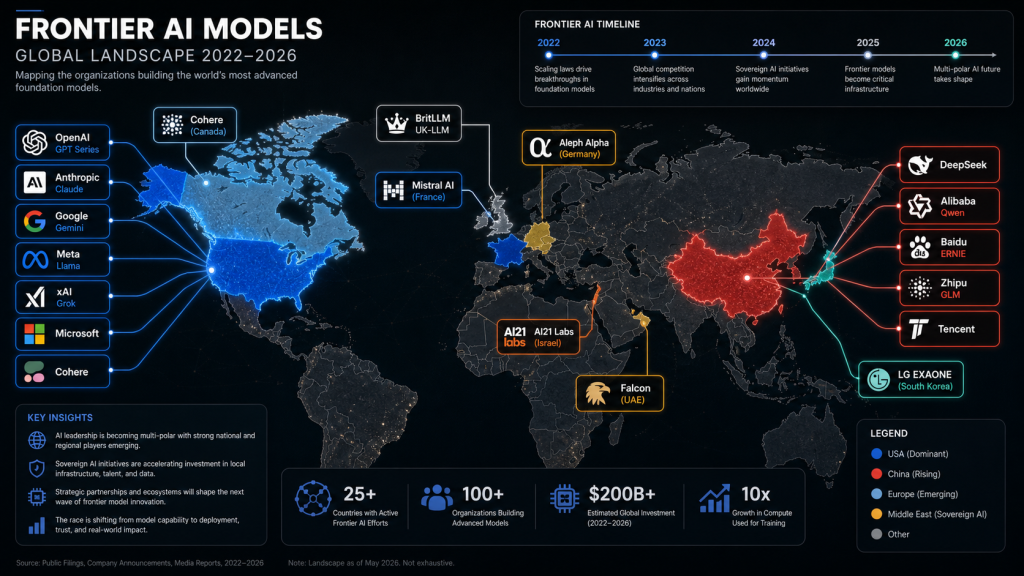
The Frontier Model Landscape: A Global Survey
The following tables map every significant frontier model by organisation, country, and launch date.
🇺🇸 United States — Dominant
The United States hosts the majority of the world’s frontier models, produced by a combination of purpose-built AI labs and technology conglomerates.
Tsinghua University spin-off; bilingual English/Chinese
Moonshot AI
Kimi
Kimi K2 (May 2026)[^61]
1 trillion parameter MoE; led Chatbot Arena rankings on launch
Tencent
Hunyuan
Hunyuan family (2022+)[^61]
Multimodal; embedded across Tencent’s product ecosystem
🇫🇷 France — Europe’s Champion
Organisation
Model Series
Key Releases
Notable Characteristics
Mistral AI
Mistral / Mixtral / Le Chat
Founded Apr 2023[^67]; Mistral 7B (Sep 2023); Mixtral 8x7B (Dec 2023); Mistral Large (Feb 2024)[^68]; Mistral Large 3 (Nov 2025)[^69]; Mistral Medium 3.5 (Apr 2026)[^70]
Open-weight philosophy; Europe’s only credible frontier model competitor; valued at €12B as of Sep 2025[^71]
Mistral was founded by three researchers who had worked at Meta and Google DeepMind. Its €105 million seed round in June 2023 was, at the time, the largest seed round in European history. The company’s open-weight approach — releasing model weights for free use — positioned it as the European answer to Meta’s Llama, with the additional claim to sovereignty: trained in Europe, on European infrastructure, for European use cases.[^71][^67]
🇬🇧 United Kingdom — Sovereign AI in Development
The UK does not yet have a frontier commercial LLM competing globally, but has significant strategic activity:
Initiative
Description
Status
BritLLM / UK-LLM(UCL + Bangor + NVIDIA)
Building an open-source LLM trained on English and Welsh language data, running on the Isambard-AI supercomputer in Bristol[^72][^73]
In development (2023–present)
Sovereign AI Unit
£500 million government fund to build and scale AI capabilities on British shores, chaired by VC James Wise[^74][^75]
Launched Nov 2025
AI Pathfinder(Government)
£150 million+ to provide secure AI infrastructure for the public sector and national security[^74]
Active 2025–26
DeepMind — founded in London in 2010 and acquired by Google in 2014 — remains the UK’s most consequential AI contribution. AlphaGo (2016) and AlphaFold (2020) are arguably the two most important scientific AI achievements of the past decade, though both are products of a US-owned entity.
Open-sourced under Apache 2.0; government-funded by Abu Dhabi’s ATRC; positioned as “made-in-UAE AI”
The UAE has arguably the world’s most ambitious sovereign AI strategy of any middle-power nation, including a dedicated Ministry of AI — possibly the first such ministry globally. Falcon has consistently ranked in the top tier on the Hugging Face Open LLM Leaderboard among non-US/non-China models.[^76][^77]
🇩🇪 Germany — Enterprise Sovereignty
Organisation
Model
Launch
Characteristics
Aleph Alpha
Luminous / Pharia
Luminous (2022)[^79]; Pharia-1 7B (2025)[^79]
Sovereign LLMs; focuses on multilingualism, explainability, EU regulatory compliance; German, French, Spanish, Italian
Black Forest Labs
FLUX (image generation)
2024
Image generation models; used by xAI’s Grok for image capabilities[^43]
Founded 2017; pioneered commercially available large language models; enterprise focus
🇨🇦 Canada
Organisation
Model
Launch
Characteristics
Cohere
Command / Aya
API (2021), Command (2022)[^59], Command R (2024)[^88], Command A (Mar 2025)[^60], Command A+ (2026)
Founded by Transformer paper co-author Aidan Gomez; enterprise and multilingual focus; $5.5B valuation[^59]
Other Notable Global Contributions
Country
Organisation
Model
Notes
🇸🇬 Singapore
Menlo Research
Jan
Open-source; Southeast Asian language focus[^89]
🇨🇭 Switzerland
Swiss AI Initiative
Apertus
Fully open (data, training code, weights); ~Llama 3 level performance[^89]
🇮🇹 Italy
Sapienza NLP / CINECA
Minerva
Trained on 500B+ Italian words; national language AI[^79]
EU (multi-country)
EuroLLM Consortium
EuroLLM-9B
Covers all 24 official EU languages plus 11 more; 4T+ token training[^79]
Part 9: What Held AI Back — A Structural Analysis
For anyone presenting on AI history, it is useful to characterise the brakes on progress structurally, not just chronologically.
The Three Recurring Constraints
1. Compute Every AI winter was, at its root, a compute problem. The algorithms researchers imagined in the 1950s and 1960s required hardware that would not exist for 30–50 years. Even the expert systems of the 1980s required expensive, specialised LISP machines. The GPU revolution of the 2000s — originally a gaming technology — was the single most important enabling factor in modern AI, making it economical to train large neural networks.[^37]
2. Data Statistical machine learning requires large, labelled datasets. These did not exist in usable form until the internet created massive passive data generation, and until projects like ImageNet (2009) created structured labelled corpora. Modern foundation models are trained on essentially the entire digitised output of human civilisation — something that was physically impossible at any earlier point.[^32]
3. Funding and Institutional Access AI research from 1956 to roughly 2010 was accessible only to those with institutional backing: military agencies, elite universities, and large corporations. The academic research community could study and publish, but training cutting-edge models required resources that only DARPA, IBM, or Google could provide. This is why the democratisation of AI via open-weight models (Llama, Mistral, Falcon) and consumer interfaces (ChatGPT) is genuinely historically significant — it ended 65 years of structural exclusivity.
The Hype Cycle Problem
AI has a well-documented tendency to overpromise. Minsky’s 1970 prediction of human-level AI “within 3–8 years” is merely the most famous example. Each wave of excitement has attracted funding, which attracted promises, which attracted disappointed funders, which caused winters. The pattern is visible across:[^16]
1960s optimism → First AI Winter (1974)
Expert systems hype → Second AI Winter (1987)
1990s neural network enthusiasm → narrow and slow progress through the early 2000s
Current LLM excitement → concerns about a potential third cooling period
Understanding this cycle is essential for any professional presenting on AI’s trajectory.
Conclusion: A Field 80 Years in the Making
The AI that became visible to the world in late 2022 was not invented in 2022. It was the product of:
1943: The first mathematical model of a neuron (McCulloch & Pitts)
1950: The first formal framework for machine intelligence (Turing)
1956: The naming and formalisation of the field (Dartmouth)
1963–1974: $100M+ in US military funding building the research foundations
1980s: The first commercial AI deployment at scale in corporate settings
1986: Backpropagation making deep networks trainable (Hinton, Rumelhart, Williams)
1997: Deep Blue proving machines could outperform humans in bounded tasks
2009: ImageNet providing the data infrastructure for deep learning
2012: AlexNet demonstrating the power of deep convolutional networks
2017: The Transformer architecture making large language models possible
2020: GPT-3 demonstrating emergent few-shot learning at scale
2022: ChatGPT making 80 years of research accessible to anyone with internet
The geography of frontier AI is not accidental. American dominance reflects decades of DARPA investment, world-class universities, and the concentration of talent and capital in Silicon Valley. China’s rapid rise reflects determined national strategy, enormous domestic data, and the efficiency-driven innovation forced by US chip export restrictions. France’s Mistral reflects the strength of European mathematical traditions and a deliberate open-weight strategy. The UK’s BritLLM and sovereign AI unit reflect the recognition that dependence on US or Chinese AI infrastructure carries geopolitical risk. The UAE’s Falcon reflects the most explicit governmental AI sovereignty project outside the major powers.[^61]
AI has always been a geopolitical technology. That has not changed. What has changed is that, for the first time in its 80-year history, it is also yours.




 On 30 November 2022, OpenAI released ChatGPT — a conversational interface built on GPT-3.5 — to the general public, free of charge. It reached one million users in five days. 100 million users in two months. No technology in history had been adopted at that speed. For the first time in 80 years of AI history, anyone with internet access could interact directly with a frontier AI system. The exclusivity that had defined the field since 1956 was over.[^41]
 The following tables map every significant frontier model by organisation, country, and launch date.